Your Personal Soundtrack for a Quieter Mind
More Than Just Background Noise
Have you ever settled onto your cushion, taken a deep breath, and prepared for a moment of peace, only to have your neighbor’s dog begin its daily operatic solo? We’ve all been there. It’s easy to think of music for meditation as just a shield to block out the world. But what if it could be more than that? What if it were an active tool to guide your mind where you want it to go?
Choosing a soundtrack is like choosing your mental environment. It’s less about drowning out distractions and more about inviting in a specific feeling, whether that’s calm, focus, or gentle awareness. For those just starting to explore this inner world, learning the basics of meditation can be a wonderful first step. This journey is about matching sounds to your goals, understanding the gentle science behind them, and building a personal playlist without any pressure. Think of yourself as the DJ for your own inner peace party. You’re in charge of the vibe.
Matching Your Music to Your Meditation Goal

Once you decide to use music, the next question is, what kind? The answer depends entirely on what you’re hoping to achieve in your session. It’s not about finding one perfect track, but about curating a collection that supports your different intentions. For moments when your mind feels like a browser with too many tabs open, the goal is deep relaxation. This is where you can find calming music for anxiety, like gentle instrumentals, ambient soundscapes, or nature sounds. Their slow, predictable tempos act like a lullaby for your overactive nervous system. If you're looking for inspiration, the music meditations we've curated offer a great starting point.
On the other hand, if you need to enhance your focus for a work task or a creative project, you might want something different. Steady, minimalist electronic music or consistent, non-lyrical rhythms can provide an anchor for your attention, helping to quiet the mental chatter without putting you to sleep. The most important rule, however, is personal preference. If a track of "calming ocean waves" just makes you need to visit the restroom, it’s not the right sound for you. Your body’s response is the ultimate guide. What feels soothing and supportive is always the right choice.
| Meditation Goal | Recommended Music Type | Why It Works |
|---|---|---|
| Deep Relaxation & Stress Relief | Ambient music, nature sounds, slow piano/cello | Slow tempos and no sudden changes help lower heart rate and calm the nervous system. |
| Enhanced Focus & Concentration | Minimalist electronic, steady rhythms, binaural beats (Alpha waves) | Consistent, non-lyrical sound provides an anchor for the mind, reducing mental chatter. |
| Emotional Healing & Uplifting Mood | Solfeggio frequencies (e.g., 528Hz), gentle chants, uplifting instrumentals | Certain tones are believed to resonate with the body's energy centers, promoting balance and positivity. |
| Creative Visualization | Expansive soundscapes, cinematic instrumentals | Evocative music can help stimulate the imagination and deepen immersive mental imagery. |
Note: This table offers a starting point. The most effective music is always what feels most resonant and supportive to you personally.
The Gentle Science Behind the Sound
As you explore meditation music, you might come across terms like "binaural beats" and "solfeggio frequencies." They can sound a bit technical, but the ideas behind them are quite simple and worth exploring with a sense of gentle curiosity. It’s less about rigid science and more about what you feel.
Binaural Beats: A Clever Trick for Your Brain
Using binaural beats for focus is a fascinating audio experience. It works by playing a slightly different frequency in each ear through headphones. Your brain, in its clever way, perceives a third, rhythmic pulse at the mathematical difference between the two tones. This process, known as brainwave entrainment, gently encourages your brain to sync up with the rhythm. For example, alpha wave frequencies are associated with a state of relaxed awareness. A 2018 review in Psychological Research noted that binaural beats can influence cognition and mood, suggesting they are a useful tool. The only catch? You must use headphones for the effect to work.
Solfeggio Frequencies: Exploring Ancient Tones
Then there are solfeggio frequencies healing tones, like the often-cited 432Hz or 528Hz. These are ancient scales believed to resonate with the body’s natural vibrations. Some people find that 528Hz, the "love frequency," feels uplifting, while others feel grounded by 432Hz. The best approach is to experiment without expectation. These tones are thought to correspond with the body's energy centers, a concept you can explore further in our chakra meditation course. To find them:
- Search streaming platforms for "528Hz," "alpha wave binaural beats," or "solfeggio frequencies."
- Listen to a few different tracks and notice how your body feels.
- Don’t worry about the numbers. Just pay attention to what feels good.
Crafting Your Personal Zen Playlist

Now for the fun part: becoming the curator of your own peace. Learning how to create a meditation playlist is a personal and creative process. Instead of searching for one perfect, all-purpose list, consider making a few for different moods. You could have a "Morning Focus" playlist with steady rhythms, an "Afternoon Reset" with uplifting instrumentals, and an "Evening Unwind" playlist filled with soft, ambient sounds.
A good guideline is to stick with music that has no lyrics. Words tend to engage the analytical part of our brain, the very part we’re trying to quiet. The exception can be gentle, repetitive mantras or chants in a language you don’t understand, as they can become part of the hypnotic soundscape. When building your playlist, think about its flow: start with something gentle to ease you in, move into the core of your soundscape, and end with a track that softly fades, allowing for a smooth transition back into silence. For those who prefer a ready-made experience, our guided meditation journeys already have the perfect soundscape built in.
- Use keywords: Search for "ambient," "sound bath," "instrumental," or "soundscapes."
- Explore platforms: YouTube and Spotify have vast libraries of meditation music.
- Organize your finds: As you discover tracks you love, organizing them can be a mindful practice in itself.
Setting the Stage for a Distraction-Free Session
You’ve found the perfect track, but your peaceful state is suddenly shattered by a loud car insurance ad. The environment and technology you use are just as important as the music itself. Jarring advertisements or poor audio quality can pull you right out of a meditative state. To avoid this, consider using a premium streaming service or downloading your favorite tracks for offline listening.
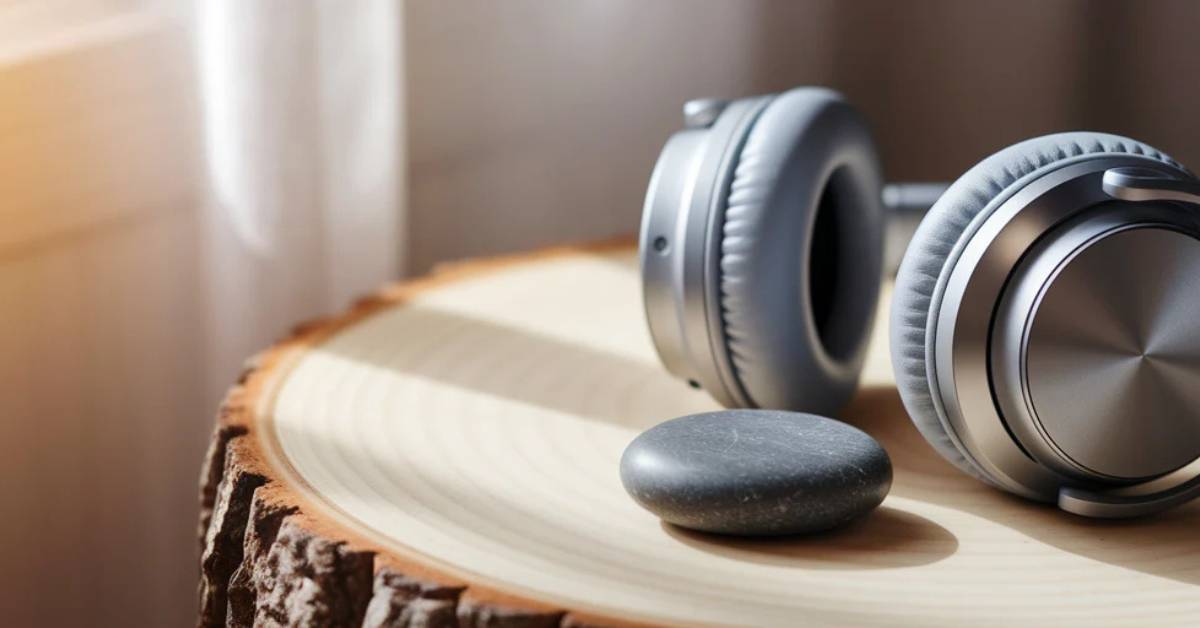
Headphones are your best friend here. Think of them as a gentle "do not disturb" sign for your brain. They create an immersive bubble of sound that blocks out external noise and helps you turn your attention inward. Noise-canceling headphones are a fantastic tool, especially if you live in a busy household. Finally, connect your audio experience to your physical one. Pairing your soundtrack with a comfortable seat, dim lighting, or a cozy blanket completes the ritual. It sends a clear signal to your body and mind that it’s time to rest. You can find a moment of peace anywhere, even by learning how to practice shower meditation in the middle of a busy day.
Your Gentle Start to a Sound Journey
If all this feels like a lot, let’s simplify. You don’t need to become a sound-healing expert overnight. Here is your gentle first step: choose one calming song you enjoy. Just one. Set a timer for five minutes, put on your headphones, and listen. There’s no goal other than to simply hear the music. Let go of any pressure to have a "perfect" or "deep" meditation session.
This entire process is about playful exploration. It’s an intuitive dance of discovering what sounds help you feel more centered, calm, and connected to yourself. There are no rules to follow, only your own inner guidance. Your ideal soundtrack is a reflection of you, and it will change and grow as you do. Have fun exploring the sounds of your own inner peace. The journey is the destination.